360degree visibility
Discover, monitor, assess, and govern agents, copilots, automations, identities, and AI workloads.
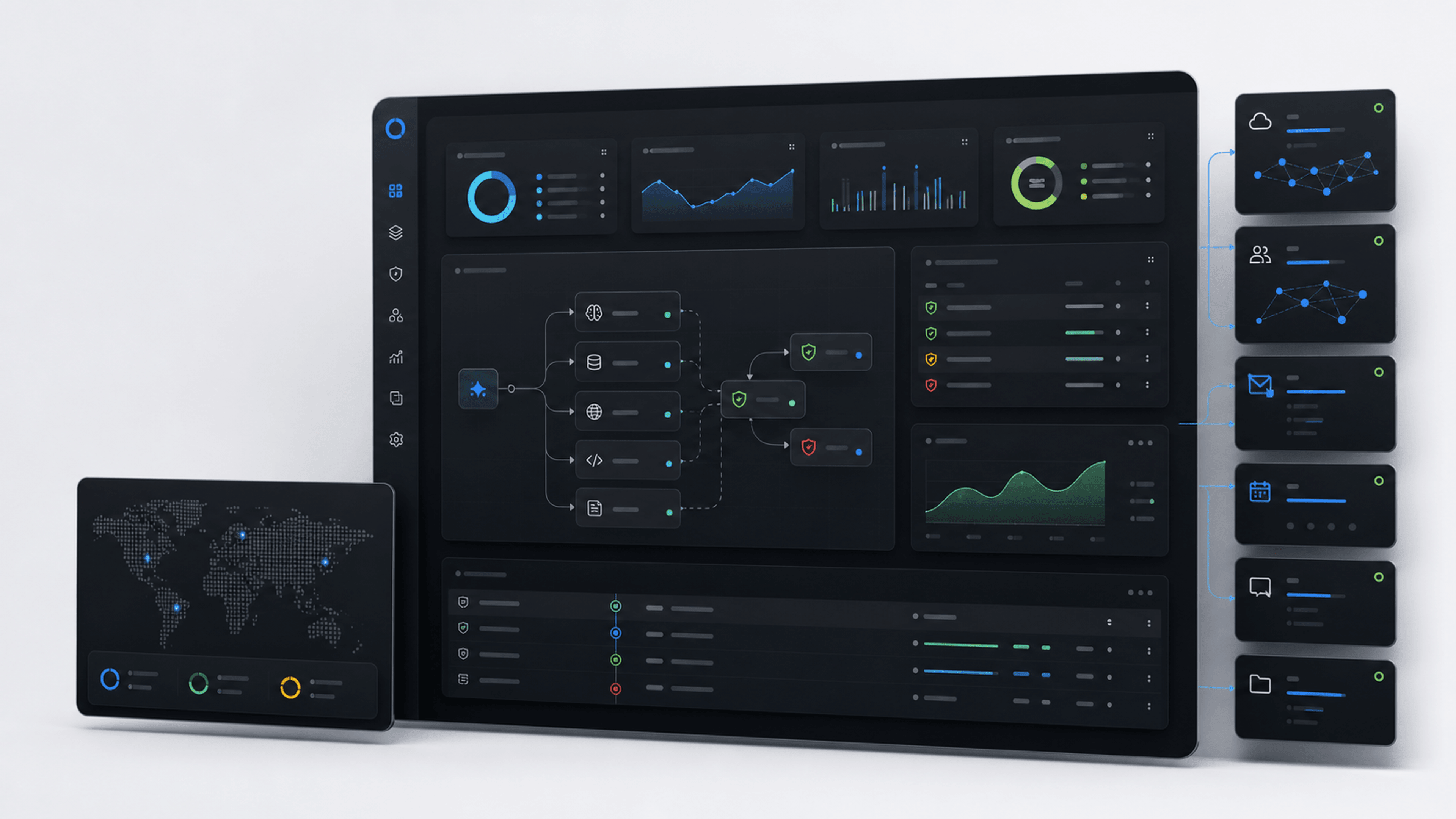
AI Governance · Observability · Control
Orbit is the enterprise control layer for discovering, monitoring, governing, and securing AI agents across the modern organization.
Orbit helps enterprises discover, monitor, assess, and govern AI agents, copilots, workflows, automations, and AI-connected identities across Microsoft, cloud, enterprise, and AI platforms.
Discover, monitor, assess, and govern agents, copilots, automations, identities, and AI workloads.
Discovery, inventory, risk, permissions, data map, observe, compliance, audit, alerts, insights, API, and control.
Orbit is not an agent builder. It is the governance and observability platform above them.
Operating Flow
International enterprise buyers need to understand how the control layer works before they trust the product. Orbit makes the lifecycle legible from registration through runtime proof.
Orbit captures owner, purpose, permissions, tools, and intended business workflow before the agent becomes operational.
Identity, data access, tool authority, and exception thresholds are checked against enterprise policy.
Signals from activity, drift, risk, and approvals are correlated into a control-ready operating view.
Approvals, exceptions, actions, and outcomes are preserved for compliance, incident review, and executive reporting.
The Problem
Enterprises are rapidly adopting AI agents, copilots, automation flows, and AI-powered integrations. But most organizations cannot answer basic governance questions before these systems become operational risk.
Which AI agents, copilots, automations, and AI-connected identities already exist across the enterprise?
Who created them, which systems do they access, and which data sources can they read or modify?
Which actions have they performed, which risks do they introduce, and which compliance obligations are affected?
Without visibility, there is no control. Without control, there is no governance.
Who Orbit Serves
Enterprise agent governance is not owned by one function. Orbit gives security, compliance, and platform teams a shared language for approval, evidence, and operational control.
Gain visibility into AI adoption, operational transparency, and governance maturity across the enterprise.
Reduce AI-driven security risk by finding overprivileged agents, risky permissions, suspicious changes, and critical exposure.
Generate evidence, warnings, reports, and defensible records for regulation, security reviews, and internal audits.
Create policy enforcement, oversight, and a shared operating model for the growing landscape of agentic systems.
Scale AI governance across customers with tenant-aware inventory, risk, evidence, alerts, and reporting.
The Solution
Orbit provides a unified governance platform for AI agents, copilots, automations, service principals, AI workloads, and agentic systems. It does not build agents. It governs them.
Continuously find AI agents, copilots, automations, service principals, AI workloads, owners, systems, and data access.
Calculate transparent risk scores from permissions, data sensitivity, activity patterns, external connections, and system criticality.
Observe executions, API calls, changes, errors, system interactions, and operational behavior after deployment.
Produce audit evidence, surface alerts, report to leadership, and prepare teams for regulation, reviews, and active control.
Core Value Proposition
The platform brings discovery, monitoring, assessment, evidence, alerts, reporting, and oversight into one operating layer for AI governance.
Discover all AI agents and AI-related assets across the organization
Build a centralized inventory of agents, owners, systems, permissions, and data sources
Understand risk levels through transparent scoring and evidence
Detect overprivileged agents and dangerous permission combinations
Map which agents access which systems and data
Monitor agent activity and operational behavior
Generate compliance and audit evidence
Alert teams when critical changes or violations occur
Provide executives with clear AI governance insights
Prepare for AI regulation, security reviews, and internal audits
Control Loop
The strongest enterprise AI programs will not rely on one-off reviews. Orbit frames agent governance as a loop that can be inspected, tightened, and proven over time.
Agents, owners, tools, connectors, privileges, and declared business purpose enter one governed inventory.
Orbit compares runtime intent, permissions, data context, and policy coverage before risk becomes invisible.
Critical actions move through approval paths, exception rules, and authority limits matched to enterprise policy.
Every decision, action, policy state, and review outcome becomes traceable evidence for accountable operations.
Live Governance Simulation
A mature control layer should make autonomy visible in motion: who owns the agent, what it is trying to do, which policy applies, and what evidence is created.
Agent event stream
Runtime risk
Policy gate
Sensitive data gate
Decision
Human approval required
Evidence output
Owner, policy, scope, and decision captured
Real Orbit Surface
Orbit provides centralized visibility for inventory, risk scoring, permission analysis, data access mapping, compliance evidence, audit history, alerting, reporting, and executive oversight.
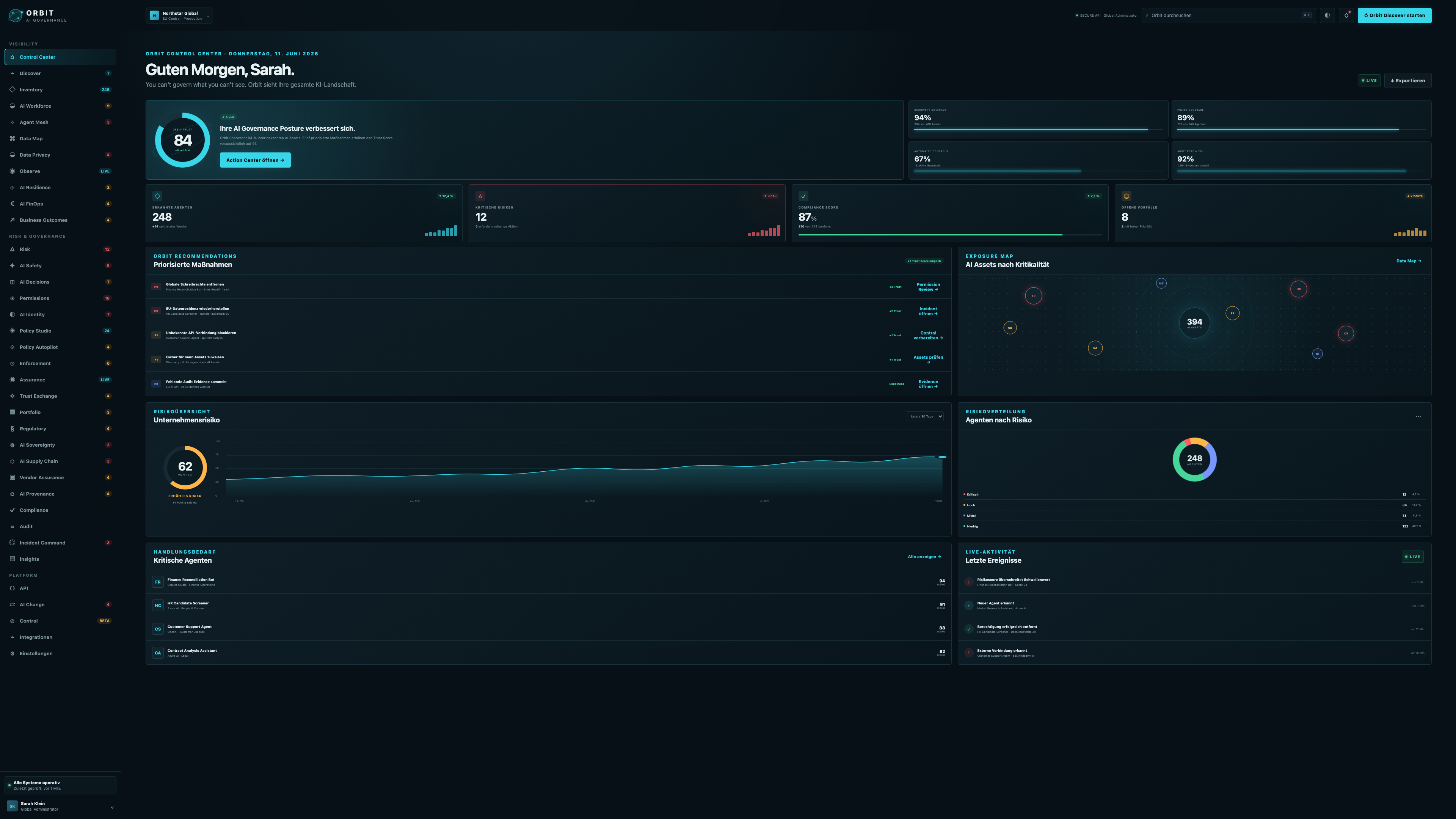
Orbit Modules
Orbit gives enterprises the visibility, evidence, and control required to operate AI agents safely, securely, and responsibly.
Automatically identifies AI agents, copilots, automation flows, service principals, agent identities, and AI-connected workloads across the enterprise.
Provides a centralized, searchable, tenant-aware source of truth for agents, owners, platforms, status, risk, permissions, and data sources.
Evaluates each agent with a structured risk model across permissions, data sensitivity, activity, external connections, compliance exposure, and system criticality.
Detects overprivileged agents, orphaned service accounts, risky Graph permissions, elevated Azure roles, and dangerous API access patterns.
Visualizes how agents interact with SharePoint, Outlook, SQL, Graph, cloud services, and other enterprise data sources.
Tracks executions, API calls, errors, changes, system interactions, and activity evidence after AI systems are deployed.
Evaluates agents against frameworks such as the EU AI Act, GDPR, ISO 27001, NIS2, SOC 2, and internal corporate policies.
Creates an immutable-style history of who changed what, when it changed, what the previous state was, and what the new state became.
Notifies the right teams when new agents, new permissions, risk increases, violations, or critical configuration changes appear.
Turns technical signals into executive dashboards for AI growth, risk trends, compliance posture, open incidents, and governance maturity.
Exposes governed access to inventory, risk, compliance, audit evidence, alerts, reports, and operational insights.
The future active intervention layer for disabling agents, revoking permissions, enforcing approvals, and requiring policy exceptions.
Control Architecture
Orbit is designed as the control layer between enterprise AI systems and the teams accountable for risk, identity, compliance, security, and business outcomes.
Microsoft-first Positioning
Orbit is positioned for organizations standardizing identity, data protection, security operations, and AI enablement around the Microsoft ecosystem.
Designed for Microsoft-first enterprises with existing identity, security, and compliance programs.
Control concepts aligned with Entra, Purview, Defender, Microsoft Graph, and Copilot Studio environments.
Built for governance teams that need shared evidence across AI, security, compliance, and operations.
Signal Stack
Orbit is designed to bring together the signals that matter to security, compliance, platform, and executive teams without forcing each team into a different view of the truth.
Owner, role, tenant, privilege
Understand who is accountable for every agent and which identities can authorize action.
Sensitivity, source, scope, retention
Connect agent activity to the data context that determines regulatory and business risk.
Connector, action, approval, blast radius
See which tools an agent can call and when human review must interrupt execution.
Activity, anomaly, escalation, drift
Convert live agent behavior into security, compliance, and platform-readable signals.
Decision, approver, policy, timeline
Preserve the facts needed to explain what happened and why it was allowed.
Security & Trust
Orbit is built around security-first principles so organizations can govern AI without exposing secrets, tokens, or sensitive credentials.
Tenant isolation and role-based access control
Signed sessions and server-side authorization
Audit evidence and immutable-style event history
Zero Trust alignment and policy decision controls
API-first architecture for secure enterprise integration
Security-focused discovery and risk analysis without exposing secrets, tokens, or sensitive credentials
Executive Outcome
Orbit turns AI complexity into executive clarity by showing what exists, what changed, where risk concentrates, and which teams need to act.
How many AI agents exist and which ones are business-critical
Where the highest risks, overprivileged agents, and dangerous permission combinations are
Which compliance areas need attention and what evidence already exists
What changed recently, which teams need to act, and where exposure is increasing
Where governance posture is improving and how leadership should prioritize action
Adoption Path
Private beta conversations should produce an implementation path that respects existing Microsoft investments, governance processes, and executive risk appetite.
Inventory agents, connectors, owners, critical workflows, and Microsoft environment posture.
Introduce policy gates, role-based review, exception handling, and operating thresholds.
Monitor risk signals, incidents, audit events, and executive readiness from one control layer.
Private Beta
AI adoption is accelerating. Governance must accelerate with it. Discover your AI landscape, understand your risk, prove your compliance, and control your autonomous systems.